# Is the Combat RPG a Useful Designation?
tags: #articles #game/wargame/five-parsecs #game/wargame/five-leagues #game/wargame/5150 #game/rpg/twilight2000 #game/rpg/bliss-stage #game/rpg/warriorheroes

> I love discovering new games that challenge my assumptions. I have long been a fan of what I call [Adventure Wargames](https://rockymountainnavy.com/2022/10/13/ttrpg-or-wargame-thoughts-on-adventure-wargames-inspired-by-five-parsecs-from-home-modiphius-2022-and-twilight-2000-freeleaguepub-2021/) like *Twilight: 2000 4th Edition* (Free League Publishing, 2019) or *Five Parsecs From Home: Solo Adventure Wargaming* (Mödiphiüs, 2021). To me, “Adventure Wargames” are games with elements of wargame and roleplaying games (RPGs) mixed together. With my recent acquisition of *Dropship* by Todd Ritzema and Nathan Lindy from Blackwall Games I now must refine my ontology of games. That is because *Dropship* is a new (to me) category of RPG I am going to call, “Combat RPGs.”
I had the pleasure of this article across my feed earlier today. I thought it was very interesting because it's not something I haven't been considering myself.
There is a very fruitful space that has been explored from both sides by wargames and RPGs over the last couple of decades, where individual strands are growing toward one another and entangling, turning into specific games which broach some kind of unexpected hybrid. There are some older examples of games in this space and quite a lot of newer ones, and this actually connects up to some debate that's been going on in the recent social media space regarding, "how to play D&D."
It's a chunkier topic than I usually take on in one of my thoughts posts, so this is actually going to be an article with headings and stuff. I know, it's crazy. Madness, really. Rocky can blame only himself.
## First What Is It?
Look, I don't know what to tell you. You're going to have to start off by reading Rocky's original article, which is essentially [a relatively lightweight overview and review of what he refers to as a combat RPG published by Blackwall Games, *Dropship*.](https://rockymountainnavy.com/2026/07/07/ttrpg-roll-26-30-a-combat-rpg-in-dropship-blackwall-games-2026/) This has been a game kicking around in my "I should look at this" list for a bit, so it's nice to see somebody else pick it up for me. I'm endlessly appreciative.
Go read the article, then come back here. Trust me.
So right, let's cut to the end of his article and then we will double back. Rocky is attempting to assemble an ontology of games in the space and has started from essentially a trifecta Venn diagram with board games, wargames, and role-playing games representing the three sets within which games may be placed. This has the obvious visual advantage of being immediately clear that there are games within the overlaps of those things, and that thus those are interesting places to look for games.
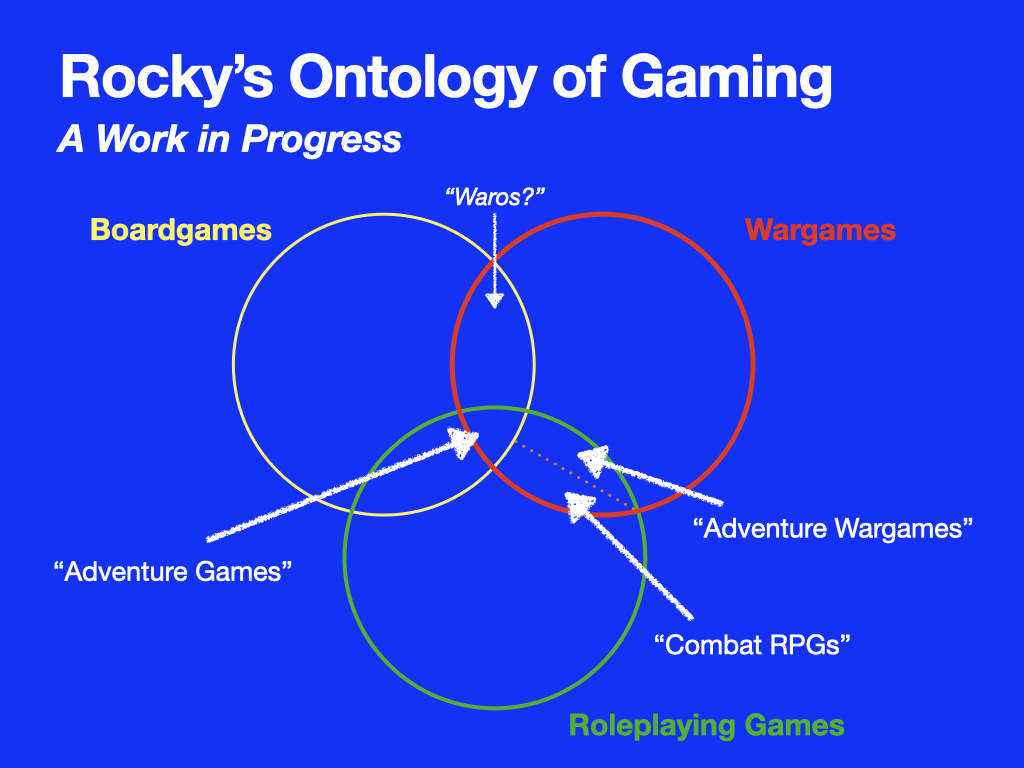
I don't disagree with the basic idea. However, I disagree with the idea that there needs to be a terminological distinction between [[Adventure Wargaming|adventure wargames]] and combat RPGs because I think it ignores an essential fact that these are members of the same spectrum and not two denotationally different types of thing. Once you introduce the idea that these are terminologically different, you start looking for ways to differentiate them rather than to see how they are alike.
I'm going to ruin this whole thing and say that my ultimate suggestion would be to not introduce a new term at all, but simply accept that the overlap between role-playing games and wargames is properly called *Adventure Wargames*. I'll go a step further and say that games which are directly in the center of that overlap of all three shouldn't be referred to as any particular kind of game at all, but simply referred to as "games." I know, this is heady stuff and deep on the philosophy. It's okay, you'll be all right.
## How'd We Get Here?
Let's roll back in time a little bit, because I want to talk about one of my favorite publishers. Two Hour Wargames was founded by Ed Texiera in the year 2000, but it wasn't the first thing that he published. In 1998, he put out *Warrior Kings*, which was a medieval mass combat skirmish combat system, which eventually led to the 2000 release of *[[Warrior Heroes|Warrior Heroes]]*, a fantasy skirmish combat game which focuse(s|d) largely on man to man combat up to company-sized conflicts. After that came *Chopper Chicks slash Guns N' Girls*, which was modern pulp skirmish. *Chain Reaction*, the first distillation of the core engine that future THW games would make use of. *FNG* in 2005 for your Vietnam era squad level combat. Critically, also *All Things Zombie*, which is often billed as a survival horror skirmish engine but really solidified what you might think of as the distillation of THW in the space of adventure wargames. *ATZ* was not just all about going out and shooting zombies in the head. There was a lot of that, but there was also rules for building up your own community, scavenging resources, interacting with other survivors, both cooperatively and violently, with mechanics extremely lightweight and simplified as they were, for managing all of those things. Then came *[[5150]]* in August of 2006, which was their full stack science fiction approach to combat and exploration—and incidentally solidified their position as adventure wargame creators. The seeds certainly existed far back to 2003 and beyond, arguably even 2000 with *Warrior Heroes*.
Now, obviously, Two Hour Wargames is not the only wargame producer to have made solo rules, co-op rules, or rules which merge gently over into the RPG world. Arguably, you could say that RPGs were born originally from tabletop strategic and tactical wargames, and the RPG elements that we think of as inherent today were strapped on over time. The fact is that first came more coherent and cohesive settings, which designers wanted characters to be able to interact with in a more mechanical way, and thus came the process of mechanization of that interaction beyond just whether or not you could beat the snot out of something.
However, it's over the last couple of decades that we see more RPGs, which aggressively moved away from wargaming as a significant part of the game itself, moving back toward more classical combat as part of the core game loop. As we see wargames move further away from pure wargames to taking on more elements of character uniqueness, customization, characterization, and so on.
Certainly not a new situation. Certainly there are plenty of examples of hybrids which long predate this moment. We could even talk about the evolution of Warhammer 40K through purely tabletop wargaming and skirmish to wanting ways to represent that in a role-playing context and putting out games like Rogue Trader. There's always been that sort of handoff, but the last 20 years have really cranked up the volume on it across the board.
## Category Error
We've established there's a long history of crossover and that the last couple of decades have been really exciting for people who want to walk that area between pure character/plot-driven RPG and scenario/procedural wargaming.
But why not just inject a new term to specifically talk about "combat RPGs" if these are obviously a thing that exist? It's because they're not an obvious thing that exists. That line is way too hazy to be able to differentiate, and it's way too hazy even within the games being described and categorized in the article *Between Tables*.
Let's take as an example *[[Twilight 2000]]*. Is it very capable of being run as a series of skirmishes, with the RPG connective tissue essentially just giving a reason to go from one to another? Sure. But that doesn't really make it any different from any other RPG in history.
As long as there are combat systems which can be enjoyable to manipulate, there are people who play the game solely to get from one combat to the next with little interest in what characters think or how they interact with the social context. They just want to stab things in the face.
You can play even the most narratively fiction-forward game in that way if you want; it's in direct opposition to how the mechanics want you to work it, and you have to really enjoy what it is they do, but you can certainly do it. So that really doesn't help us differentiate things until we start trying to interpret intent, and intent is always secondary to what things actually do, and what things actually do isn't so well defined.
*Twilight 2000* has an entire buttload of rules for engaging with other people, building a community, negotiating and managing that whole side of the game, certainly and especially in fourth edition. I suspect that's one of the great things about the game as a whole. While it does have some very crunchy simulationist mechanics for combat, it also wants to simulate things beyond that. It, in short, wants the characters to be on an adventure, even if that adventure is in a soft apocalyptic wasteland full of miserable Europeans.
*[[Lancer]]* is very much a combat-focused game, both by intent and by design — but it has entirely too much worldbuilding and interpersonal description to be seen as a combat RPG per se. There's no reason for you to absolutely feel compelled by going to war every session. There's plenty of things going on in the universe that don't involve spiritually corrosive giant robots that eat into your mind every moment that you're sitting in the cockpit (though that is a pretty cool part).
Let's face it, there is a hundred pages of background information in *Lancer* from page 334 up to 423. This is an 8.5x11, rather small print book with not a whole lot of white space. Yes, a good chunk of the mechanics are about making things that beat each other up. But there's more than mech combat in the game. If *Lancer* needs the special nomenclature of "combat RPG" then so does the *[[Dungeons and Dragons|D&D]] Cyclopedia* for the same reasons.
The Colonial Marines campaign in *[[Alien - The Roleplaying Game|Alien: The Roleplaying Game]]* is a **very** interesting choice to cite because it's not a game. It is a particular series of scenarios which form a campaign, which can be played by a game which runs in a whole bunch of different ways.
In fact, one could argue that the classic approach to Alien with a small group of people trapped on a ship or station with a group of aliens that they can't actually hope to physically overcome through combat is the antithesis of a combat RPG. Seeking and engaging in combat is a recipe for disaster. The Colonial Marines campaign subverts that in a fairly significant way, focusing on the fairly solid combat mechanics of a good game without wholly abandoning the themes themselves. It's a fine example of a combat-focused campaign designed for an RPG which generally teaches players to avoid combat.
This puts its finger more solidly on why the categorization as given just isn't great. Playstyle is more important to the differentiation than mechanics. D&D is a fine example of a game which can be classified on either side of the same line, not just on different tables, but the same table on different days, or under a different rotating GM with the same characters in the same setting.
Now let's flip over to the other side and look at what I consider a very solidly wargame-focused example of the adventure wargame field, *[[Five Parsecs from Home]]*. Again, most of the mechanics are very much about how to work the buttons and levers of skirmish warfare. Very little of the player mechanics actually involves negotiation or socialization.
The bits that are involved, getting a job, getting paid, keeping up the ship, doing repairs, healing up your guys for the next fight.
However, in a relatively short book, under 200 pages, and in my favorite A5 format, nearly 10 pages are taken up talking about the setting itself and the world. When you get down to the appendices, which are fantastic for a multitude of reasons, down on 153, you find something very interesting. A discussion of the Story Track, which has a really interesting first paragraph.
> The Story Track is a way to plan a story arc into your campaign. It does not replace the normal campaign game. Instead, as you play, certain events take place, forcing you to deal with them. The Story Track is an optional addition to the core game. It is recommended that you wait until at least your second campaign before employing it.
Interestingly, this **does** start folding in interaction with other people, in particular patrons and rivals. In some degree, it does work as an even more focused way to channel between various skirmishes.
But it's fascinating in that essentially it sets up a pre-existing storyline, which can be run by a third party or played cooperatively or solo. Given that the rest of the standard campaign is entirely procedurally generated, this nod to slotting in pre-created series of events which hinge on interactions and socializations that you've had earlier in the game is really impressive. This is definitely Wargaming working its way back toward RPGs from the Wargaming side of the world.
The other interesting thing is right there on page 152, the facing page across the spread, **Appendix IV: Problem Solving**. It's slightly less than half a page, but it's critically interesting stuff because it talks about how to resolve questions which aren't directly related to conflict that they are relegated to optional rules, specifically being intended for creative players to toy with, is amazing. That is, it leaves one amazed. There's an architecture of potential there, and it was deliberate.
If you pull up the *Five Parsecs From Home: Compendium* you see that it's even more moving toward some RPG solution approaches. In particular, the No Minis Combat Resolution System would fit into any lightweight RPG as its entire combat system. Get down to the Scenarios and Settings section with factions being a larger part of play, stealth missions, street fights, and salvage jobs coming up, and you really have something that is pushing even further into that space.
What I'm saying here is that I don't have a problem with referring to *Five Parsecs From Home* as an adventure wargame in any way, shape, or form, but it is a lot less wargame than it might initially appear.
Looking at Ivan Sorensen's other work and pulling up *[[Five Leagues from the Borderlands]]* is really interesting in the context of this discussion too, because as the fantasy side of his 5X design space, you can see there being more focus on RPG-like interactions, particularly in the adventuring stage. Exploring locations, and encounters with various people who aren't trying to kill you necessarily. Not to mention the overall complexity of the procedurally generated game space. *Five Leagues* leans heavily in on building out that wider experience. Pull up the *Compendium* for *Five Leagues* and you will see even more things, particularly in the activities section, like going fishing, bounties, caravans, fighting competitions, and lore research.
Again, a game which is clearly firmly within the adventure wargame space, but not purely limiting itself to wargame interactions or pushing harder into that, instead reaching across to being ever more an RPG.
## Bogo, Bogwar, Warboard?
For the record, I hate the name "[Waros](https://boardgamegeek.com/wiki/page/Waros)",[^1] and I think it's terrible. It's a bad retro construction, and really, if you're going to be specific about it, should only refer to wargames which lean heavily on the Eurogame experience, rather than board games in general. There are games which live in the liminal space between wargames and boardgames. I believe the one that jumps to mind immediately is [the Lock 'n Load implementation of damn near anything, but particularly *All Things Zombie*](https://lnlpublishing.com/products/all-things-zombie-reloaded).
It is very much a chit and hex board game/wargame experience. Though this does bring up a bit of a problem when it comes to this classification scheme one more time: where do you put games like the classic chit and hex wargames? Clearly they are wargames; it's there in the title. But they also have an extreme focus on board understanding the abstraction of play pieces which don't physically represent what they are, and being driven by cards and other randomizers which are not inherently wargame-like. What of Twilight Struggle, which isn't quite a card game, and it isn't quite a board game, and it isn't quite a wargame, but it is something of all of the above.
We're bumping into the problems with this nomenclature in that I think it's just too ambitious in its classification.
## RPGoards?
This brings us all the way back around over to the hole in the Venn diagram, the overlap between board games and RPGs. It is a fair cop that Rocky isn't aware of any game that fits into that slot because it is an extremely rarefied slot. The people who want to play an RPG generally don't want to deal with the physical complexity of board games. Those who love board games are not generally showing up to play a role-playing game in which socialization and recontextualization through a player avatar is what they're looking for.
Except for *Twilight Imperium* players, but they're a unique breed. We don't talk about them.
There are RPGs which lean heavily on a sort of managing board state as part of operating the game itself. They are rare, but they exist.
*Miss Schiffer's School for Young Ladies of Quality* was published in the early 2000s by Vincent Baker's wife, Meguey Baker.
Now, normally you would expect me to have a link to something that discussed that game or someplace you could buy it or people playing it. Yeah, I'm pretty sure I'm the only one that ever played that game and ever ran that game (at a convention even). Or perhaps even heard of that game. I have a copy in hard copy on my shelf, but no digital version seems to have ever been released. You want to talk about a collection which contains obscurities? Here mine is. Holy crap.
Short version: The protagonists are all girls at a girls' school and part of creating the setup is that you draw relationship lines between them on a big sheet of poster board or paper and note what those relationships are. As gameplay goes on, things get more complicated. Scenes are inspired by unresolved issues, which you can see cleanly displayed right there on the table in front of you. Engaging in play means that you adjust the terms on those relationships or move tokens which represent weight around, etc. Physically, it is very board game-like if a board game which involves mapping out nodes. Mechanically, it was kind of a mess and I never touched it after the first time.
Not just because the theme doesn't really suit me, but the mechanics were just too fiddly.[^2]
Another board game influenced RPG is one that I've run multiple times and several times at conventions, and that's *[[Bliss Stage]]*. At the beginning of the game, you set things up by creating three by five cards with various slots on them representing possible outcomes. During play, conflicts require you to roll a fistful of Fudge dice (which have two plus faces, two minus faces, and two blank faces) and allocate them to the various things which need to be dealt with, which means you're going to be making some hard choices on a regular basis. The very literal map of crises and problems builds out on the table, and where you physically place the tokens of your character attention is very board game like, despite the fact that the game itself is very much a role-playing game. The mechanics echo resource allocation games.
Those are the only two that come to mind right off the top of my head, which says something about how common the crossover between board games and RPGs must be. Of course, you can always roleplay in a board game, and somehow that seems to happen on a regular basis, even when playing Monopoly. How often does the little dog bark as someone moves it around the board or the race car go vroom?
## Closing the Sanctum
Let me cut to the chase. I think the problem here is multifold.
Firstly, I don't think the term combat RPG brings something useful to the table. My suspicion is that Adventure Wargame is more than fit to the space, and really the only argument against it is the fact that even today a lot of RPG players stigmatize wargames and consider themselves to be above such things. Any terminology which suggests that a game might have something to do with a wargame immediately makes it a lowbrow form of entertainment in their minds.
I don't think it's worth catering to that opinion. I think it's stupid and self-destructive, and if it keeps those people from enjoying things that they would otherwise take pleasure in. I'm okay with that. They deserve the suffering.
Secondly, I don't think that a Venn diagram is the best way to visualize this ontology because there are no tightly circumscribed circles. The sets are not that well defined.
If anything, this really describes a set of vectors in 3D space, with one axis being board games and one being wargames and one being RPGs, and an individual game having some sort of measure which states how far that particular descriptor applies. This is a messy, blurry, awkward kind of presentation, but I think it's more realistic to the actual space being represented.
I think it also helps highlight the problem in that there is no binary representation. It's all just multiple spectra.
Thirdly, I don't think board games belong on this, and when you take them out, what you get is a single axis spectrum, which runs from totally wargame to totally RPG with things dropping in between. This actually gives us a metric that we could, in theory, begin to put games on by doing a binary piecewise comparison between them and saying, "do I think this game is more RPG than that game?" It's an actual relational question that we could answer, whereas clustering them within sets doesn't really do the job. You're trying to do with a binary division of language (combat RPG versus adventure wargame) what some sort of relational representation would do better.
Anyway, those are my thoughts. It was a particularly well thought out article, and I thought it deserved a well thought out response. Hopefully, those along for the ride enjoyed it.
[^1]: For the record, I've never heard a single person actually refer to any game using this term, and it hurts my brain that somebody decided that it probably needed to exist.
[^2]: If that's the sort of thing you're into, might I suggest *[[Best Friends]]* by Gregor Hutton, which is quite possibly the best realization of that kind of social experience I've ever seen.
Check it out.